90% Of College Students Use AI: Higher Ed Needs AI Fluency Support Now
Key Takeaways
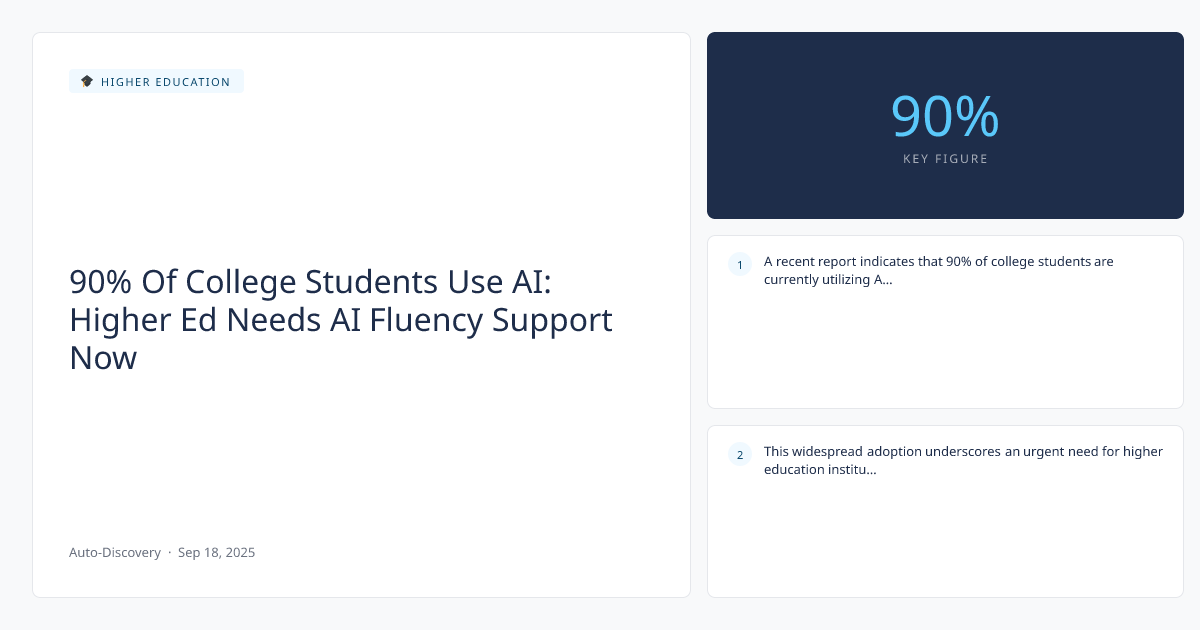
- •The statistic that 90% of college students use AI underscores a fundamental shift in learning methodologies, demanding an urgent pivot in higher education towards proactive AI fluency support.
- •This necessitates that educators move beyond policing AI to integrating its ethical and effective use into curriculum design, preparing students for an AI-pervasive professional landscape where critical human-AI collaboration is paramount.
A recent report indicates that 90% of college students are currently utilizing AI tools. This widespread adoption underscores an urgent need for higher education institutions to develop and implement robust support systems to foster AI fluency among students.
Our Take
The statistic that 90% of college students use AI underscores a fundamental shift in learning methodologies, demanding an urgent pivot in higher education towards proactive AI fluency support. This necessitates that educators move beyond policing AI to integrating its ethical and effective use into curriculum design, preparing students for an AI-pervasive professional landscape where critical human-AI collaboration is paramount.
Topics & Tags
Analysis & Perspectives
Strategic Planning for AI Professional Development: Equipping Educators to Integrate AI as a Pedagogical Partner, Not Just a Tool
This article outlines a strategic framework for professional development, empowering educators to effectively integrate AI into their teaching practices. It moves beyond viewing AI as a mere tool, instead focusing on equipping educators to leverage AI as a sophisticated pedagogical partner. The aim is to enhance learning experiences and foster innovative instructional design.
Redefining Assessment and Feedback Strategies in the Age of Generative AI: From Plagiarism Detection to Promoting Critical AI Literacy
This article explores how the advent of generative AI necessitates a fundamental re-evaluation of assessment and feedback strategies in education. It advocates for a shift from solely focusing on plagiarism detection towards cultivating critical AI literacy among students. The piece outlines innovative approaches to integrate AI responsibly, ensuring academic integrity while equipping learners with essential skills for an AI-driven world.
People Also Ask
What is the best AI tool for students?▾
Is it cheating to use AI as a student?▾
How can AI help students learn more effectively?▾
Are there free AI tools for students?▾
Related Articles
University of Idaho Faculty Senate approves new AI, law and construction program
The University of Idaho Faculty Senate has approved a new interdisciplinary program. This innovative offering uniquely combines studies in artificial intelligence, law, and construction, marking a new educational pathway at the university.
Interest in Law School Is Surging. A.I. Makes the Payoff Less Certain.
Interest in law school is experiencing a significant surge. However, the increasing prominence of artificial intelligence is casting doubt on the long-term career payoff and certainty of employment for those pursuing a legal education.
AI is rewriting online education into a cognitive service
AI is fundamentally transforming online education from a passive content delivery model into an active, personalized cognitive service. This evolution means AI will adapt learning experiences to individual student needs, actively fostering critical thinking and deeper understanding through intelligent, tailored support.