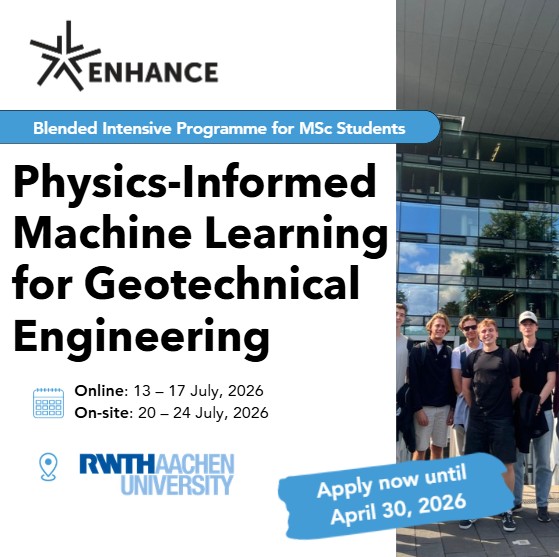
Summer School in RWTH Aachen: Physics-Informed Machine Learning for Geotechnical Engineering
Key Takeaways
- •This summer school exemplifies a crucial trend in AI's maturation: its deep integration into specialized STEM fields, leveraging domain expertise to solve complex engineering challenges rather than solely relying on data-driven approaches.
- •The focus on "physics-informed" machine learning underscores the growing demand for models that respect fundamental scientific principles for robustness and interpretability in critical applications.
- •For educators and institutions, this necessitates a proactive shift towards interdisciplinary curriculum design, preparing students with both advanced AI competencies and profound disciplinary understanding for future innovation.
Skip to the main menu Skip to search Skip to content Summer School in RWTH Aachen: Physics-Informed Machine Learning for Geotechnical Engineering | Gdańsk University of Technology Page content News Date added: 2026-04-09 Summer School in RWTH Aachen: Physics-Informed Machine Learning for Geotechnical Engineering Apply now for the international Physics-Informed Machine Learning for Geotechnical Engineering programme, hosted by RWTH Aachen University as part of the ENHANCE Alliance.
Our Take
This summer school exemplifies a crucial trend in AI's maturation: its deep integration into specialized STEM fields, leveraging domain expertise to solve complex engineering challenges rather than solely relying on data-driven approaches. The focus on "physics-informed" machine learning underscores the growing demand for models that respect fundamental scientific principles for robustness and interpretability in critical applications. For educators and institutions, this necessitates a proactive shift towards interdisciplinary curriculum design, preparing students with both advanced AI competencies and profound disciplinary understanding for future innovation.
Topics & Tags
Analysis & Perspectives
Strategic Planning for AI Professional Development: Equipping Educators to Integrate AI as a Pedagogical Partner, Not Just a Tool
This article outlines a strategic framework for professional development, empowering educators to effectively integrate AI into their teaching practices. It moves beyond viewing AI as a mere tool, instead focusing on equipping educators to leverage AI as a sophisticated pedagogical partner. The aim is to enhance learning experiences and foster innovative instructional design.
Redefining Assessment and Feedback Strategies in the Age of Generative AI: From Plagiarism Detection to Promoting Critical AI Literacy
This article explores how the advent of generative AI necessitates a fundamental re-evaluation of assessment and feedback strategies in education. It advocates for a shift from solely focusing on plagiarism detection towards cultivating critical AI literacy among students. The piece outlines innovative approaches to integrate AI responsibly, ensuring academic integrity while equipping learners with essential skills for an AI-driven world.
Related Articles
Jisc and EAUC Launch new guide to help Universities and Colleges act on the Environmental Impact of AI
New practical guidance aims to bridge the gap between the accelerated development of AI tools and sustainability ambitions across UK post-16 education and research Launching… Jisc and EAUC Launch new guide to help Universities and Colleges act on the Environmental Impact of AI was published on FE News by Jisc
An Ambitious Course on the Future of AI Ends with a Flourish
An Ambitious Course on the Future of AI Ends with a Flourish Stanford Graduate School of Business
Generative AI Pervades Higher Education: Here’s How Three Institutions Responded
Generative AI Pervades Higher Education: Here’s How Three Institutions Responded The Swarthmore Phoenix