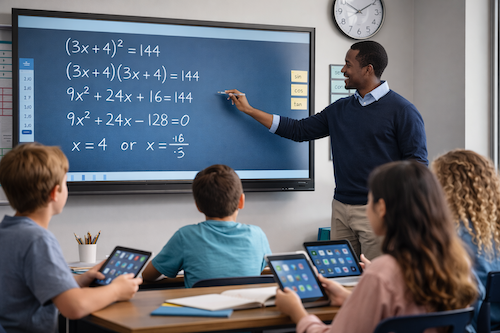
It's time to rewrite math standards for the future--and to stop expecting AI to do it for us
Skip to content Share on X (Opens in new window) X Share on Facebook (Opens in new window) Facebook Share on LinkedIn (Opens in new window) LinkedIn Email a link to a friend (Opens in new window) Email Print (Opens in new window) Print Key points: Math experiences should build understanding, purpose, and agency Boosting student engagement on World Math Day The next wave of innovation: How educators are shaping the future of edtech For more news on math learning
Topics & Tags
Analysis & Perspectives
How AI Grades Handwritten Math (And Where It Still Struggles)
AI grades handwritten math by reading the page with specialized handwriting recognition, then evaluating each step of a solution rather than just the final answer. Here is how that pipeline works and where it still breaks down.
What AI Grading Analytics Reveal About Learning Gaps
AI grading analytics turn a pile of scores into concept-level diagnoses, showing exactly where a class or student is stuck. Here is how educators can read that data and act on it.
People Also Ask
What is AI tutoring?▾
How effective is AI tutoring compared to human tutoring?▾
Is AI tutoring free?▾
What subjects can AI tutors teach?▾
Related Articles
Students Will Take the Lead on Crafting a Model AI Policy for Schools
Students Will Take the Lead on Crafting a Model AI Policy for Schools Education Week
US Education Department Finalizes AI Grant Priority, Balancing Innovation With Safeguard
US Education Department Finalizes AI Grant Priority, Balancing Innovation With Safeguard CDO Magazine
Here are the HISD schools that will become AI-focused 'Future 2' schools
Here are the HISD schools that will become AI-focused 'Future 2' schools Houston Chronicle